


What Is Sodium Bicarbonate Used for in Industrial Processing and Water Treatment?
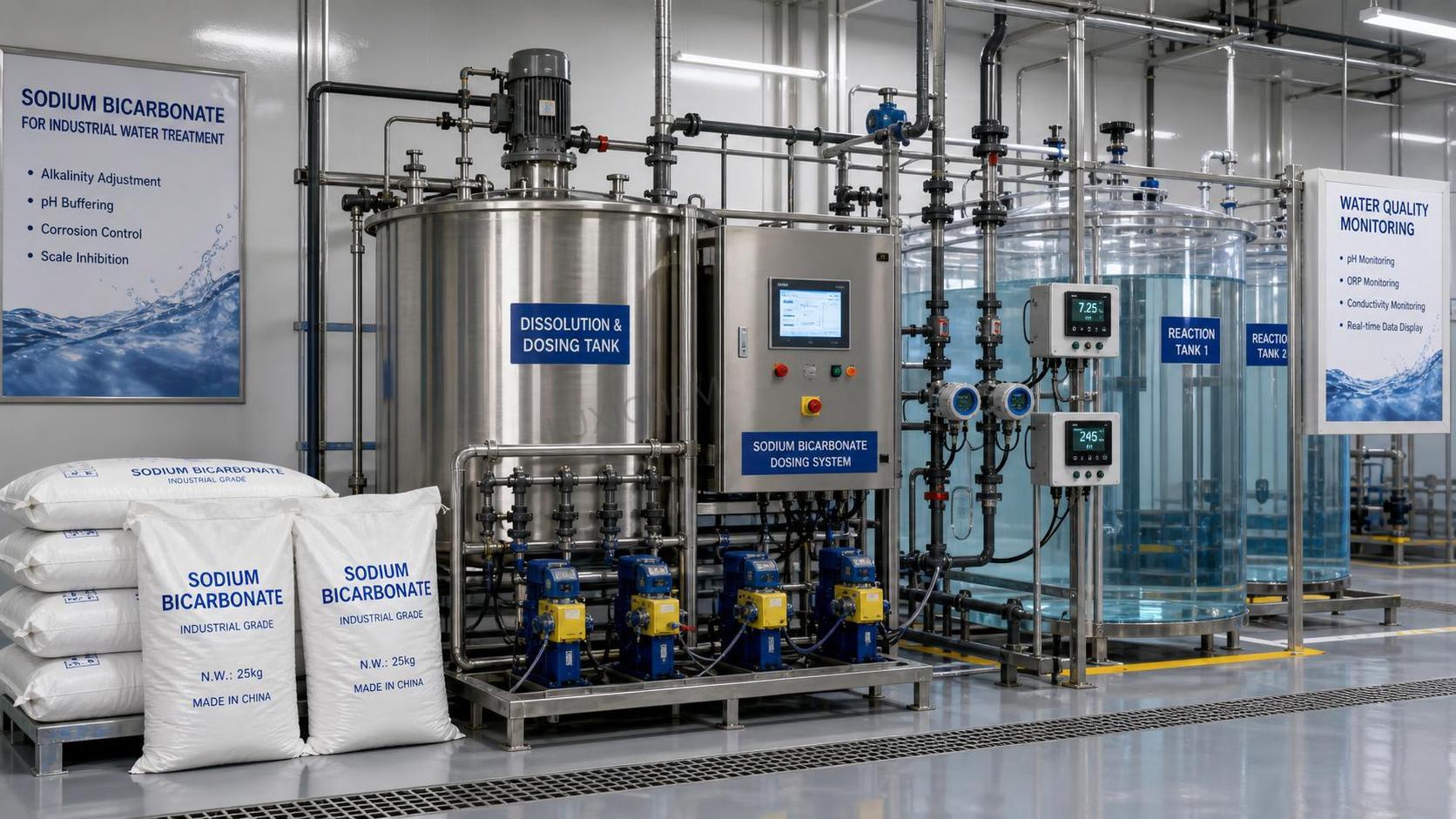
Sodium bicarbonate is widely used in industrial processing and water treatment because it is a mild alkaline material that can adjust pH, neutralize acidic conditions, and support cleaner, more stable operating environments without the handling profile of stronger caustics. In practical terms, it is often selected when a process needs measured alkalinity rather than aggressive correction. That distinction matters in systems where corrosion control, worker handling, downstream compatibility, or sludge behavior are part of the decision.
In water treatment, sodium bicarbonate is commonly associated with alkalinity management. Raw water, recycled process water, and wastewater streams can all experience unstable pH when dissolved acids, acidic salts, or biological activity consume buffering capacity. A simple pH reading does not tell the whole story. If alkalinity is too low, the system may swing quickly after the addition of acid, oxidants, or coagulants. Sodium bicarbonate adds bicarbonate ions that help resist sudden pH change, which can make clarification, filtration, and discharge control easier to manage.
This buffering function is one reason sodium bicarbonate appears in treatment trains that include neutralization tanks, equalization basins, softening units, membrane pretreatment, or biological stages. In aerobic treatment, for example, nitrification can consume alkalinity. Where that demand is not balanced, pH may drift downward enough to interfere with microbial activity. A bicarbonate source can be introduced to maintain a workable range, though the actual dosing point depends on residence time, mixing intensity, and whether the plant is correcting a chronic deficit or handling intermittent acidic loads.
Why industry often prefers it over stronger alkalis
Compared with materials such as sodium hydroxide or lime, sodium bicarbonate usually gives a gentler response. It dissolves into a system that already contains water and contributes alkalinity without the same exothermic handling concerns associated with concentrated caustic solutions. That can reduce overshoot risk in processes where the target is narrow and where overcorrection would create scale, product instability, or unnecessary salt loading. The tradeoff is that sodium bicarbonate is not the fastest or strongest route when a stream is severely acidic or when very high pH must be reached.
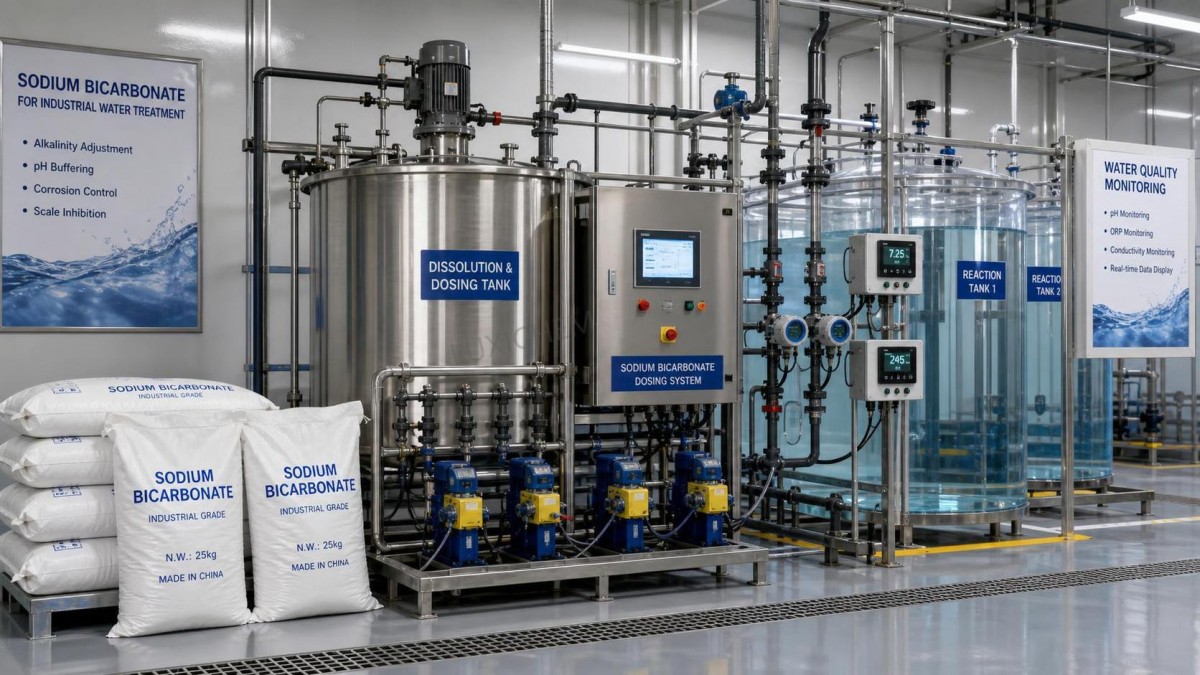
That balance affects equipment selection and operating practice. A plant that feeds sodium bicarbonate in powder form may rely on a dry feeder, dissolution tank, eductor, or make-down system. If it is used as a prepared solution, agitation matters because incomplete dissolution can leave residue in the day tank or lead to uneven feed concentration. Operators sometimes assume that a mild alkali can be added with little process control, but poor mixing near the injection point may still create local concentration pockets and unreliable pH readings.
Use in neutralization and acid-bearing process streams
Many industrial streams develop acidity during washing, pickling, scrubbing, fermentation, resin regeneration, or byproduct separation. Sodium bicarbonate can be used to neutralize those streams when moderate correction is enough and when the process benefits from a controlled reaction. In gas scrubbing or odor-control contexts, it may be applied to acidic compounds under conditions where the target is partial neutralization rather than complete conversion under highly alkaline chemistry.
It is also used in some cleaning and maintenance operations. Deposits formed from acidic residues, light fouling, or unstable reaction byproducts may respond well when bicarbonate is part of the cleaning program. The mechanism is not universal; it depends on the soil type, temperature, contact time, and whether surfactants or chelating agents are present. In blended cleaning formulations, a wetting component such as Sodium dodecyl sulfate CAS#151-21-3 may appear in a different formulation context to improve surface contact, although sodium bicarbonate itself is primarily being chosen for alkalinity and mild neutralization rather than detergent strength.
A frequent misunderstanding is to treat sodium bicarbonate as a direct substitute for any alkaline reagent. It is not interchangeable in every reactor or treatment basin. If the process requires rapid elevation to a strongly alkaline condition, bicarbonate may respond too slowly or plateau before the desired setpoint is reached. When calcium hardness is present, the change in carbonate equilibrium can also influence precipitation behavior, which means the dosing strategy should be reviewed alongside scaling tendency, not just pH response.
Water treatment roles beyond simple pH adjustment
In corrosion-sensitive systems, sodium bicarbonate may be used to support stable water chemistry by increasing alkalinity and moderating aggressive water conditions. Low-alkalinity water can be corrosive to pipelines, tanks, and ancillary equipment, especially where metal surfaces are exposed to fluctuating chemistry. A bicarbonate addition does not solve every corrosion problem, since dissolved oxygen, chloride content, temperature, and flow regime also matter, but it can be part of a broader control approach where water is too soft or insufficiently buffered.
In coagulation and flocculation steps, treatment chemicals may consume alkalinity. If alum or ferric salts are being used, the process can become less predictable when the incoming water has weak buffering capacity. Under those conditions, bicarbonate can be fed upstream or into a flash-mix zone to stabilize the chemistry before floc formation becomes inconsistent. The required feed location depends on how quickly the coagulant reacts and whether the plant is optimizing for turbidity removal, color reduction, or metal precipitation.
It can also support membrane systems indirectly. Reverse osmosis and ultrafiltration units are sensitive to unstable pretreatment. A feed stream that drifts in pH may alter antiscalant performance, foul membrane surfaces, or affect cleaning frequency. Sodium bicarbonate may be used in pretreatment or storage loops where moderate alkalinity is helpful, though it must be balanced against dissolved solids, carbonate scaling risk, and the chemistry of any antiscalant package already in use.
How it behaves in process conditions
Sodium bicarbonate is usually supplied as a white crystalline powder. Storage conditions matter more than some facilities expect. It should be kept dry, protected from moisture ingress, and isolated from strong acids that could trigger premature reaction and carbon dioxide release. Caking during storage can affect feeder consistency, especially in humid environments or where packaging is repeatedly opened. In larger installations, the design of hopper angles, vibration aids, and dust control becomes relevant because poor flowability can disrupt actual feed rates even when the metering equipment is correctly calibrated.
Temperature also changes its behavior. Solubility and decomposition tendencies differ from those of stronger alkalis. Under elevated heat, sodium bicarbonate can convert toward sodium carbonate while releasing carbon dioxide and water. In some process lines that may not matter, but in others it can shift the effective chemistry enough to alter results. This is one reason formulation teams and treatment engineers usually distinguish between bicarbonate-based dosing, carbonate-based dosing, and caustic dosing rather than treating them as minor variations.
When bicarbonate is dissolved for injection, water quality for make-down should not be overlooked. Hard water may contribute scale or sediment in the tank. Very cold water may slow dissolution. If the preparation tank has dead zones, undissolved solids can settle and later release in slugs, causing erratic control. A stable make-down routine often depends on batch sequence, fill volume, mixing duration, and whether the solution is used immediately or held for a period before dosing.
Operational points that affect results
Sampling and instrumentation often determine whether sodium bicarbonate appears to perform well or poorly. A pH probe located too close to the injection point may read a temporary local condition rather than the fully mixed stream. In wastewater equalization, a delayed response is common because the basin contents are not uniform. Plants sometimes increase dose based on an early reading, then discover that the mixed system later overshoots. The material itself is not necessarily the cause; the control loop and sampling location may be.
- Where acidic surges occur in batches, bicarbonate feed usually works better when tied to equalization volume and mixing time rather than to an instant pH value alone.
- In continuous systems, feed pumps and dry feeders should be checked against actual delivered quantity, because bridging, moisture pickup, or solution concentration drift can create a false impression of changing water chemistry.
- If solids are present, jar testing or bench neutralization can reveal whether bicarbonate demand is being consumed by dissolved acidity, metal salts, or side reactions that were not part of the original assumption.
Another practical issue is gas evolution. When sodium bicarbonate reacts with acid, carbon dioxide is generated. In open tanks this is usually manageable, but enclosed or poorly vented systems may need attention to pressure relief, foam behavior, or headspace conditions. In some treatment setups, bubbling can interfere with level sensors or create short-term mixing effects that look beneficial at first but do not represent true basin turnover.
Common applications in industrial sectors
Food-related processing may use sodium bicarbonate where mild pH adjustment and compatible handling are preferred, though exact suitability depends on the rest of the formulation and the required purity grade. In textile or cleaning-related process water, it may appear in neutralization or wash steps where the objective is to reduce residual acidity without exposing fabrics, surfaces, or equipment to harsh alkaline attack. Certain metal-finishing operations can also use it in intermediate treatment stages, particularly when a buffered response is preferable to abrupt caustic correction.
In flue gas and emissions-related treatment, bicarbonate can be introduced in dry or semi-dry systems to react with acidic components under selected operating conditions. That use sits somewhat apart from water treatment but reflects the same reason it remains relevant in chemical operations: controllable alkalinity with a comparatively manageable handling profile. Whether it is suitable depends on gas composition, humidity, residence time, and the target removal chemistry.
Procurement and specification work around sodium bicarbonate usually focuses on purity, particle size, moisture condition, packaging format, and intended application route. A plant using screw feeders may care about particle consistency more than a facility preparing solution in tanks. A wastewater unit concerned with storage turnover may prioritize packaging and protection from humidity. If the process includes other additives, compatibility should be reviewed in the same way one would separate a surfactant raw material such as Sodium dodecyl sulfate CAS#151-21-3 from alkalinity-control chemicals to avoid assuming they serve the same function in the system.
Sodium bicarbonate remains useful because it fits a narrow but important space in industrial chemistry: moderate alkalinity, buffering capacity, and broad process compatibility when stronger bases would be unnecessarily aggressive. Its value becomes clear when the real question is not how to raise pH as much as possible, but how to keep a process stable enough to run cleanly.
Related Picks
 Butylated Hydroxytoluene Price Drivers: Supply, Purity, and Purchasing Risk FactorsOct 21, 2026Butylated Hydroxytoluene price trends depend on supply stability, purity, logistics, and purchasing risk. Learn how to compare quotes wisely and reduce sourcing costs.
 Sodium Tripolyphosphate Price Trends: Raw Material and Energy ExposureOct 20, 2026Explore sodium tripolyphosphate price trends, from phosphate and soda ash costs to energy exposure. Learn how to compare quotes, manage sourcing risks, and make smarter purchasing decisions.
 Acetonitrile Shipment to Vietnam Successfully Dispatched; RCEP Benefits Boost Fine Chemical Trade with ASEANSep 16, 2026A shipment of industrial-grade acetonitrile from our company has recently been loaded and dispatched following the completion of standardized hazardous material packaging and container securing procedures.
 Nigerian Client’s Order of 4 Containers of Vinyl Acetate Successfully Loaded and Shipped to West AfricaSep 16, 2026We recently completed the loading of a vinyl acetate order for a Nigerian client; four containers of the product have been successfully packed and are ready for shipment to Nigeria.




Question Consultation
Send Us Your Inquiry Today

Luxi Chemical is a professional chemical product supplier with ample stock of all chemical categories and excellent quality, welcome your purchase inquiry.

