


Why sodium bicarbonate powder starts caking during storage
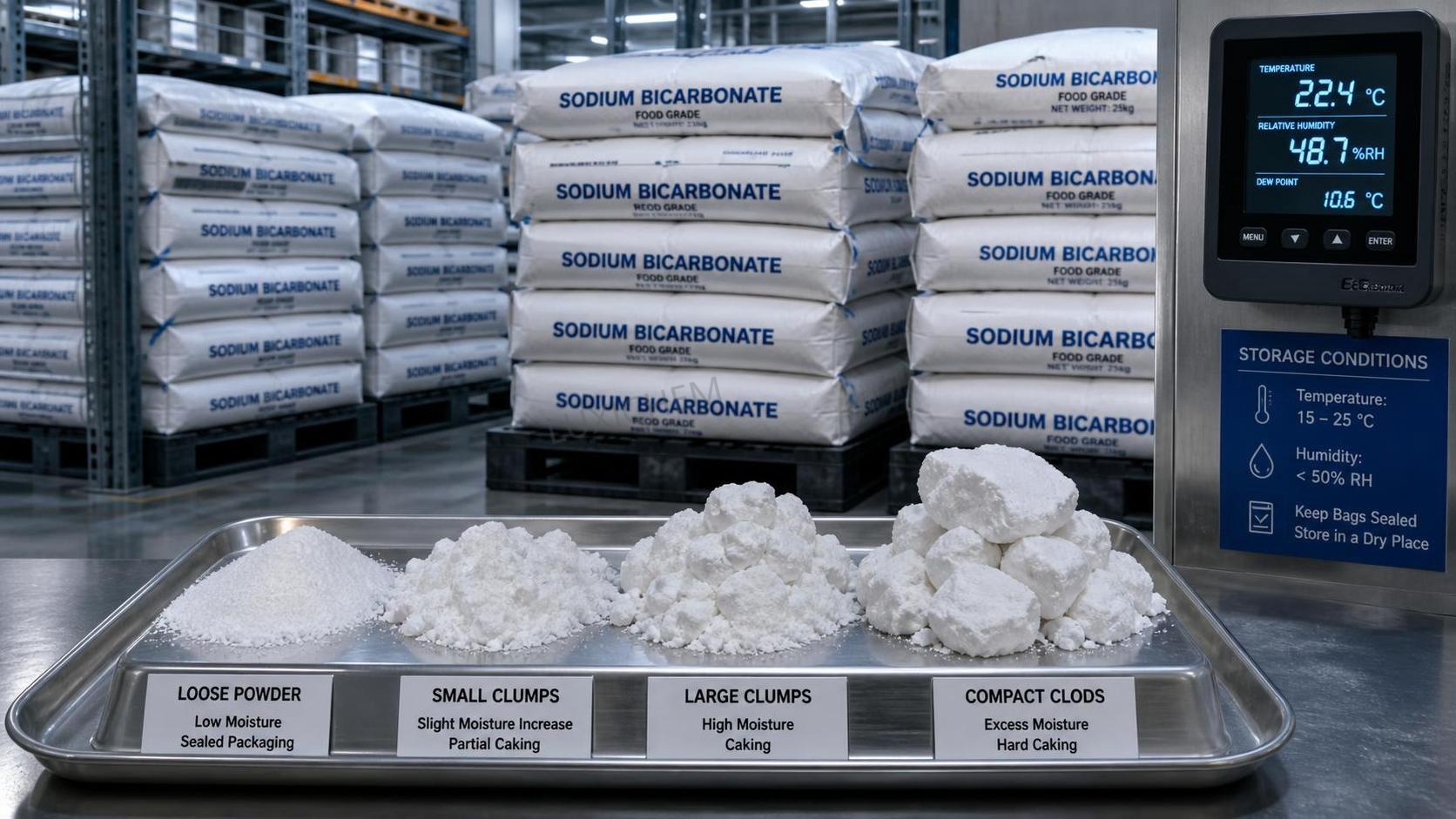
If sodium bicarbonate powder starts caking during storage, the cause is usually not mysterious. In most cases, the powder has picked up moisture from the air, gone through repeated temperature changes, or been kept in packaging that no longer protects it well. For teams handling quality complaints after delivery, the useful question is not only “why did it cake?” but “is this a storage issue, a packaging issue, or an application-side handling issue?” That distinction matters because the corrective action is different in each case.
Many people assume caking means the product is automatically poor quality. That is too simple. Sodium bicarbonate is naturally sensitive to storage conditions. Even a compliant product can form lumps if it is exposed to humid air, stacked in a hot warehouse by day and cooled at night, or transferred into partially sealed bins during use. The key is to judge how severe the caking is, what changed in the storage chain, and whether the material still meets the customer’s practical use requirements.
What usually makes sodium bicarbonate powder cake
The first cause to check is moisture absorption. Sodium bicarbonate powder is not the most hygroscopic material in the chemical industry, but it still reacts badly to damp surroundings. Once the powder absorbs a small amount of surface moisture, particles begin to stick to each other. If storage continues under the same conditions, those weak bridges harden into visible lumps.
The second cause is temperature fluctuation. This is often missed during complaint handling. A warehouse may look dry during inspection, but if the product experiences warm days and cool nights, moisture can condense inside the packaging or around the inner liner. That small amount of water is enough to start caking, especially if the powder has been stored for a long period.
The third cause is packaging failure, and this is where after-sales teams need to look carefully rather than rely on assumptions. A damaged valve bag, poor heat seal, punctured inner liner, or improper reclosure after partial use can all shorten the safe storage window. In practice, many caking complaints are linked to handling after the bag was first opened, not only to the original production stage.
A fourth cause is compression over time. Fine powder stored in large stacks can compact under its own weight. Compaction alone does not always create hard caking, but once it combines with moisture and time, the result is much worse. This is why material at the bottom of a pallet stack often cakes more severely than bags from the top layer.
There is also a simple operational reason: long storage without stock rotation. If first-in, first-out control is weak, even a stable batch can sit too long under less-than-ideal warehouse conditions. By the time the customer opens it, the powder may already have started forming lumps.
In plain terms: sodium bicarbonate powder cakes because particles get a chance to bind together. Moisture is the main trigger, temperature swings make that moisture harder to control, and weak packaging or poor storage habits give the problem time to develop.
Not all caking means the same thing
This is where field judgment matters. Soft caking and hard caking are not the same problem.
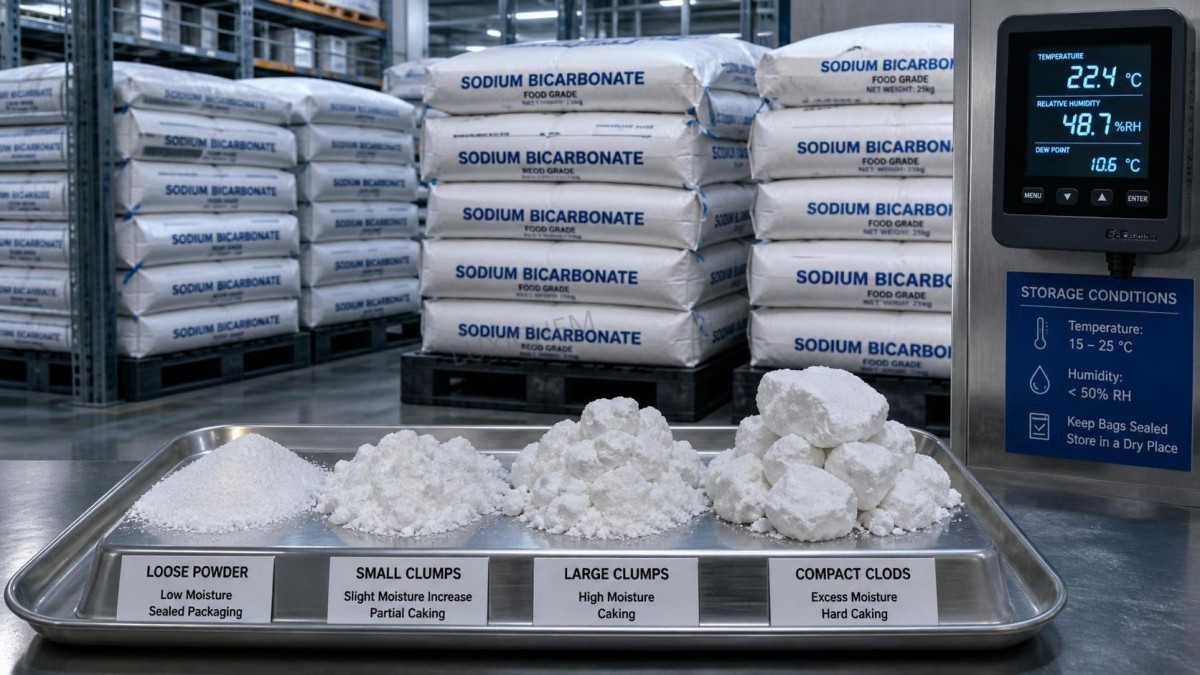
Soft caking means the powder has formed loose lumps that break apart easily by hand pressure or light mechanical agitation. This usually points to early-stage moisture pickup or light compaction. Depending on the application, the material may still be usable after screening or controlled reprocessing, but that decision should follow the customer’s process requirement and product specification.
Hard caking is different. If the lumps are dense, difficult to break, or associated with visible dampness, off-odor, or packaging deformation, the issue is more serious. At that point, you should not give quick reuse advice without checking the product’s intended end use, storage duration, and whether the material still conforms to the agreed quality standard.
A common mistake is to answer every complaint with the same line: “Please keep it dry.” That advice is correct, but too late and too vague. Customers usually want to know what failed and how to avoid a repeat incident. A useful response identifies the failure point: warehouse humidity, repeated opening, damaged liner, long storage, or local condensation.
What to check first when a customer reports caking
When you receive a complaint, start with sequence, not conclusions. Ask when the sodium bicarbonate powder was received, how long it was stored, whether the original packaging was intact on arrival, whether the bag was opened before the issue was found, and what the warehouse conditions were during that period.
Then look at the caking pattern. Uniform caking across multiple unopened bags suggests a storage or transport environment issue affecting the batch broadly. Caking only in opened bags usually points to customer-side handling. Heavy lumps near the bag wall or bag opening often suggest moisture ingress from outside air. Stronger caking at the bottom of stacked goods can indicate pressure plus time.
You should also ask whether the material was stored near steam lines, exterior warehouse walls, loading doors, or areas with day-night temperature variation. In chemical storage, location inside the warehouse can matter almost as much as the warehouse itself.
If the complaint is recurring across different products, that tells you something valuable. The problem may not be specific to sodium bicarbonate powder at all. It may reflect general site storage management. Companies with broad chemical supply experience often see this pattern across food additives, daily-use chemical raw materials, intermediates, and fertilizer-related products. Suppliers such as Luxi Chemical (Shandong) Co., Ltd., which handles a wide range of compliant chemical products for global customers, usually treat these complaints as part product review and part storage-chain review. That approach is more realistic than assuming every lump is a manufacturing defect.
In the same way, if a customer is purchasing multiple materials through one source, complaint history across categories can be informative. For example, if they are also sourcing products such as Chromic chloride hexahydrate CAS#10060-12-5, it is worth comparing how different powders or crystals are stored on site. You do not compare the chemistry directly, but you do compare handling discipline: sealing, pallet wrap, humidity exposure, and stock rotation. Those warehouse habits often explain repeated quality issues better than one isolated bag inspection.
The storage conditions that create trouble fastest
High ambient humidity is the obvious one, but partially controlled warehouses are often more problematic than clearly poor ones. Why? Because people trust them too much. A warehouse that feels “generally fine” may still allow local moisture exposure near doors, windows, roof leaks, or uninsulated walls.
Opened packaging is another high-risk point. Once a bag is opened, the original barrier performance no longer applies. If operators fold the top casually, clip it loosely, or leave it exposed between shifts, caking can start much sooner than expected. This becomes more visible in fine-grade powder because fine particles have more surface contact.
Long transit plus poor unloading practice can also contribute. If material arrives from a cooler environment and is immediately placed into a warm, humid area, condensation risk goes up. That does not always show on the outer bag, which is why teams sometimes miss it during receiving inspection.
One more detail that often gets ignored: pallets placed directly on damp floors or too close to walls. Even if water never touches the bag, microclimate humidity around the goods can be enough to start the problem over time.
How to reduce caking without overpromising
The practical fix is a combination of storage discipline and realistic communication.
Keep unopened material in its original sealed packaging until use. Store it in a cool, dry, well-ventilated area with stable temperature as far as possible. Avoid repeated movement between hot and cool zones. Do not place pallets directly against walls or on unprotected floors. If bags are opened, reseal them promptly with a moisture-resistant closure and use the remaining material quickly.
For sites with repeated humidity-related complaints, recommend checking actual warehouse humidity and temperature trends rather than relying on visual impressions. Many maintenance teams discover that the issue becomes clear only after reviewing environmental records over several days.
It is also worth setting expectations correctly. Anti-caking performance is not unlimited. Even well-made sodium bicarbonate powder can cake if storage extends too long or site conditions are unstable. The right message to customers is that product stability depends on both supply quality and storage execution.
If the customer asks whether caked material can still be used, avoid blanket answers. Soft lumps that break easily may be acceptable in some industrial processes after screening, but not in every application. Food-related or tightly controlled process uses require stricter evaluation against the relevant specification and internal quality rules. That decision should be verified case by case.
Common misunderstandings that slow down complaint handling
One misunderstanding is thinking caking only happens because the supplier sent old stock. Age can be a factor, but storage humidity and temperature swings are more common causes.
Another is assuming intact outer packaging proves the storage chain was fine. Outer bags can look normal while the inner barrier has been compromised, or while repeated opening allowed moisture in later.
A third is treating all lumping as contamination or decomposition. In many cases, it is simply physical caking. That still matters, especially for dosing and flowability, but the response should be based on evidence rather than guesswork.
Experienced teams usually focus on three questions: Did the product absorb moisture? Did the package lose protection? Did storage conditions drift outside what the material can tolerate? Those questions solve more cases than broad debates about “quality problems.”
When the issue is more likely to be on the supplier side
It is reasonable to look upstream when multiple unopened bags from the same batch show similar hard caking shortly after delivery, especially if transport and warehouse records are clean. In that case, review batch age, packaging integrity, loading conditions, and whether moisture exposure may have occurred before dispatch.
That said, supplier-side review should still be evidence-based. Ask for photos of the packaging, lot information, storage dates, and a description of the warehouse environment. Complaint handling moves faster when both sides work from the same facts.
Near the end of the process, what most customers want is not a lecture on powder behavior. They want clear guidance: whether the sodium bicarbonate powder is still usable, what caused the caking, and how to stop it from happening again. If your response covers those three points with specifics, you are usually solving the real problem rather than just answering the complaint.
And for future prevention, the most effective advice remains simple: keep sodium bicarbonate powder sealed, dry, temperature-stable, and moving through stock on time. In storage management, that routine discipline prevents far more losses than any after-the-fact correction.
FAQ
Can caked sodium bicarbonate powder still be used?
Sometimes yes, sometimes no. If the lumps are soft and the application allows screening or remixing, it may still be usable. If caking is hard, damp, or affects specification compliance, it needs further evaluation.
Is caking always caused by poor manufacturing?
No. In many cases, storage humidity, temperature fluctuation, or opened packaging is the main reason.
Does unopened packaging guarantee the powder is safe from caking?
No. It reduces risk, but does not eliminate it. Long storage, transport conditions, and barrier damage can still cause problems.
What is the fastest way to investigate a customer complaint?
Check storage time, packaging condition, whether the bag was opened, and the warehouse temperature and humidity history. Those four points usually narrow the cause quickly.
Image Placeholder List
Suggested placement: after the section discussing complaint inspection and caking pattern checks.
Suggested image content: visual comparison of soft caking, hard caking, damaged packaging, and moisture-prone storage positions in a warehouse.
Suggested alt text: Inspection points for sodium bicarbonate powder caking during storage.
Internal Link Anchor Text Suggestions
- sodium bicarbonate storage guidelines: storage and handling page
- how to prevent chemical powder caking: technical support article
- common packaging problems in chemical materials: packaging quality page
- warehouse humidity control for chemical products: warehouse management guide
- chemical raw materials supply and support: company product category page
External Authority Source Suggestions
- government or regulatory guidance on chemical storage and warehouse safety
- official technical documents from recognized food additive or chemical standards bodies
- academic or industry research materials on powder flowability, moisture uptake, and caking behavior
Related Picks
 Butylated Hydroxytoluene Price Drivers: Supply, Purity, and Purchasing Risk FactorsOct 21, 2026Butylated Hydroxytoluene price trends depend on supply stability, purity, logistics, and purchasing risk. Learn how to compare quotes wisely and reduce sourcing costs.
 Sodium Tripolyphosphate Price Trends: Raw Material and Energy ExposureOct 20, 2026Explore sodium tripolyphosphate price trends, from phosphate and soda ash costs to energy exposure. Learn how to compare quotes, manage sourcing risks, and make smarter purchasing decisions.
 Acetonitrile Shipment to Vietnam Successfully Dispatched; RCEP Benefits Boost Fine Chemical Trade with ASEANSep 16, 2026A shipment of industrial-grade acetonitrile from our company has recently been loaded and dispatched following the completion of standardized hazardous material packaging and container securing procedures.
 Nigerian Client’s Order of 4 Containers of Vinyl Acetate Successfully Loaded and Shipped to West AfricaSep 16, 2026We recently completed the loading of a vinyl acetate order for a Nigerian client; four containers of the product have been successfully packed and are ready for shipment to Nigeria.




Question Consultation
Send Us Your Inquiry Today

Luxi Chemical is a professional chemical product supplier with ample stock of all chemical categories and excellent quality, welcome your purchase inquiry.

