


What purity specs matter most when buying pure sodium bicarbonate
What purity specs matter most when buying pure sodium bicarbonate
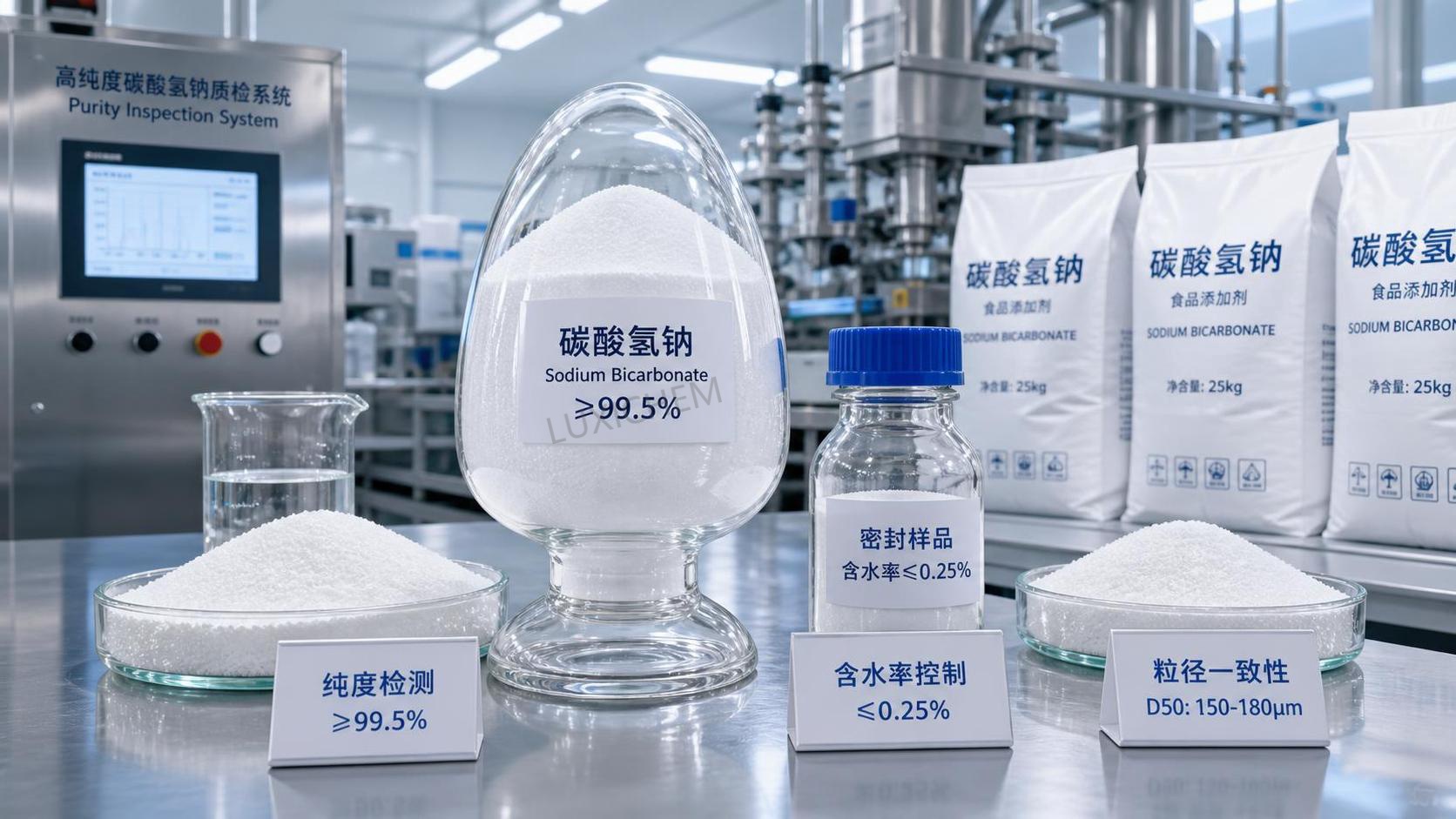
When people say they need pure sodium bicarbonate, they often start and stop with assay. That is understandable, but in practice it is not enough. Two samples can both meet a high sodium bicarbonate content and still behave very differently in processing, storage, or compliance review. For technical evaluation, the more useful question is not simply “How pure is it?” but “Which impurities, physical properties, and lot-to-lot controls can create downstream risk in my application?”
That distinction matters whether the material is going into food processing, daily chemical formulations, pH adjustment, fermentation support, or other industrial uses. In some systems, trace chloride can be tolerated; in others it can accelerate corrosion or affect taste. Moisture may look minor on paper, but it can change flowability, caking behavior, and shelf performance. Particle size may not appear under “purity” in a strict chemical sense, yet for many production lines it is one of the first things operators notice when a batch runs poorly.
A buyer comparing suppliers should therefore read a specification sheet in layers: core assay first, impurity profile second, physical consistency third, and documentation support throughout. That is usually where the real difference between a merely acceptable grade and a dependable grade shows up.
Assay matters, but it is rarely the whole story
For pure sodium bicarbonate, assay is the obvious starting point because it tells you how much active material is present. If your process relies on neutralization capacity, buffering performance, gas release, or controlled alkalinity, an unstable or marginal assay can create dosing errors. Still, technical teams usually learn pretty quickly that a strong assay number does not automatically mean a better fit.
One common issue is overvaluing a single certificate number without checking the test basis. Was the result reported on an as-is basis? Is the method aligned with the standard required in your market or industry? If different suppliers quote against different methods, the numbers may not be directly comparable. For food-related and regulated applications, this point should be checked carefully against the relevant pharmacopeia, food additive, or industrial standard rather than assumed from a marketing sheet.
Assay also becomes less informative if decomposition has already started during storage or transit. Sodium bicarbonate is not unusually difficult to handle, but it is still sensitive to heat and moisture conditions over time. A shipment that left the factory in good shape can drift if packaging, warehousing, or container conditions are not controlled sensibly.
The impurity limits that usually deserve the closest attention
Among the impurity items commonly reviewed, chloride, sulfate, and heavy metals tend to be the most commercially significant because they affect product suitability in different ways.
Chloride is often treated as a secondary item until the application makes it a problem. In stainless processing systems or equipment exposed to repeated wet cleaning, chloride can contribute to corrosion concerns, especially when other operating factors already push the system in that direction. In food and beverage applications, it may also influence taste control or specification acceptance depending on the finished product. If your plant has had unexplained equipment wear, do not assume the bicarbonate is the cause, but it is one of the easier impurity items to rule in or out.
Sulfate usually attracts attention where formulation balance, ionic load, or process water sensitivity matters. It may not trigger an obvious immediate failure, but in tightly managed systems it can create noise in quality results or require correction elsewhere. When a buyer is trying to stabilize a mature process, these “small” impurities often become more important than the headline assay.
Heavy metals deserve a stricter view. The exact specification depends on the intended use and the applicable standard, but this is not an area for broad assumptions. A supplier should be able to explain not only the reported limit, but also the control logic behind it: raw material sourcing, manufacturing route, contamination prevention, and the frequency of verification. If the product may enter food-related, personal care, or other sensitive applications, generic statements about “high purity” are not enough.
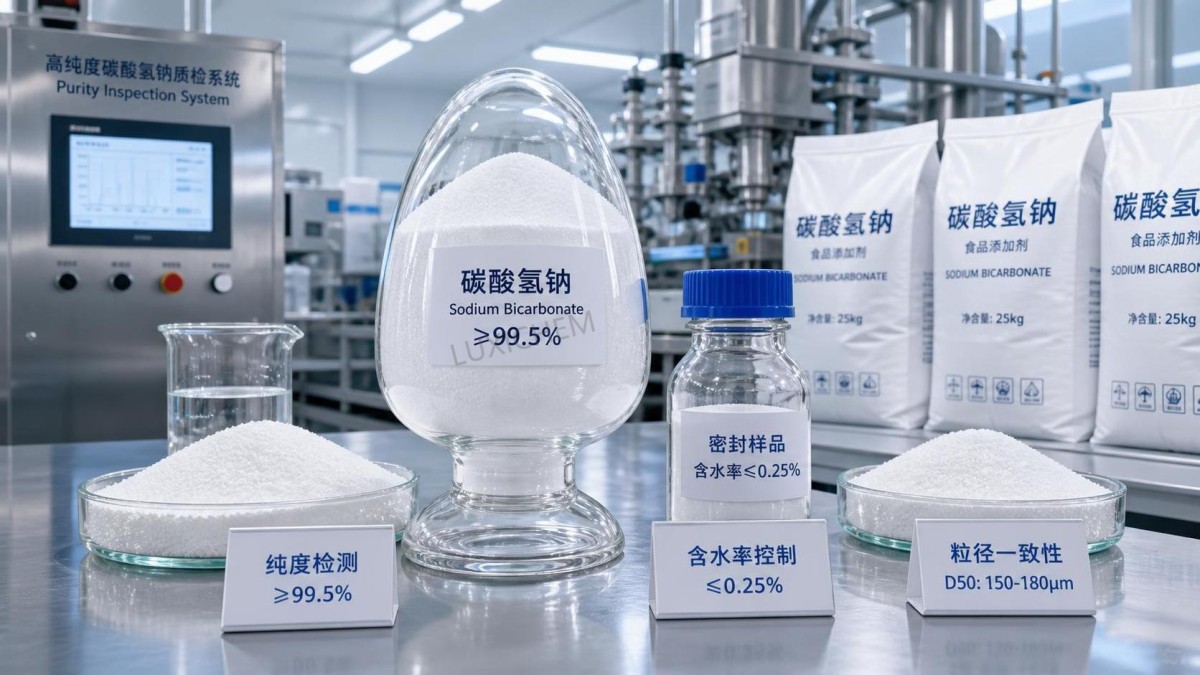
Residue-related items can matter as well, especially if the bicarbonate will be dissolved, reacted, or filtered. An impurity that is chemically minor may still create insoluble matter, haze, or filter loading. That is why technical review should connect the spec sheet to the actual unit operation rather than treat every impurity as equally important.
Moisture and particle size are where many practical problems begin
Moisture is often underestimated because buyers assume sodium bicarbonate is dry and stable by default. On the plant floor, the concern is more practical: does it free-flow, does it cake, does it feed consistently, and does it maintain expected handling performance after a few weeks in storage? Excess moisture, or even a material that is technically within spec but poorly packed, can create bridging in hoppers, dusting changes, and inconsistent dosing.
Particle size distribution is similar. A lab can sign off on composition while operations still complain that the batch does not run like the previous one. Fine material may dissolve faster but dust more. Coarser material may store better but react differently in short-contact systems. In tablet, premix, dry blending, or controlled addition processes, consistency is often more valuable than chasing an extreme number. A technical evaluator should ask not just for a nominal mesh or average size, but for the distribution and how tightly it is controlled across lots.
This broader way of thinking is common in chemical sourcing companies that manage multiple application categories. Luxi Chemical, for example, works across food additives, intermediates, fertilizers, and export trade, so the same material is not judged by one universal checklist. Buyers using one-stop procurement often find that cross-category supply partners are useful when they can discuss how spec priorities shift by end use instead of pushing a single standard grade for every scenario.
That is also why some purchasing teams compare adjacent mineral or adsorbent materials during process design, even when they are not direct substitutes. In drying, purification, or formulation support projects, a material such as Zeolite CAS#1318-02-1 may come up in technical conversations because impurity control and moisture behavior are evaluated together at the system level, not in isolation. The point is not that the materials serve the same role, but that experienced teams look beyond the single ingredient and ask what surrounding process conditions make a spec truly critical.
Documentation quality can be as important as the numbers
A specification sheet is useful, but technical evaluators usually need a fuller document set before approving a supplier. Certificate of analysis format, test methods, batch traceability, packaging details, shelf-life statement, and storage recommendations all help determine whether the product can be managed reliably after purchase. Missing information is not always a sign of poor quality, but it is a sign of higher approval effort and potentially higher risk.
There is also a difference between a supplier who can provide paperwork and one who can explain variability. If chloride, moisture, or particle size shows a trend from lot to lot, can they clarify whether that variation is normal, seasonal, process-related, or linked to a specific packaging format? Technical buyers are usually less worried by a realistic explanation than by a perfect-looking document set that leaves no room for practical discussion.
How purity priorities shift by application
Not every use profile ranks the same specs in the same order. For food processing, heavy metals, compliance alignment, sensory impact, and trace impurity control may move to the front. In general industrial processing, dissolution behavior, consistency, and packaging robustness may be just as important. In export trade, documentation compatibility with destination-market requirements can become the deciding factor even when the chemistry itself is acceptable.
This is where buyers sometimes make an avoidable mistake: they request the “highest purity available” without checking whether the highest purity grade actually matches the operating need. A tighter spec is not automatically a better purchase if it adds cost without reducing the real process risk. On the other hand, buying to a minimal standard can be false economy when downtime, rejection, or reformulation costs are much higher than the savings on price.
What to ask before you approve a supplier
A good technical review usually ends with a short list of pointed questions rather than a long generic questionnaire. Ask which specifications are routinely controlled and which are only tested periodically. Ask whether the reported values are typical results or release limits. Ask how the product is packed for humid or long-distance shipment. If you expect repeated orders, ask what the supplier considers normal lot-to-lot variation and how they manage process consistency.
For global buyers, logistics discipline should not be separated from purity review. A stable product at origin can become a complaint at destination if bags are weak, pallets are poorly protected, or transit conditions are not considered. Companies with established export experience across multiple regions often add value here simply because they understand the link between technical quality and delivered condition.
If there is one practical takeaway, it is this: when buying pure sodium bicarbonate, the most important purity specs are the ones that can realistically disturb your process, your compliance position, or your customer acceptance. Assay opens the discussion, but chloride, sulfate, heavy metals, moisture, and particle consistency usually decide whether the material will perform quietly over time. A careful approval process should compare those items against your actual application, not against an abstract idea of purity.
Related Picks
 Butylated Hydroxytoluene Price Drivers: Supply, Purity, and Purchasing Risk FactorsOct 21, 2026Butylated Hydroxytoluene price trends depend on supply stability, purity, logistics, and purchasing risk. Learn how to compare quotes wisely and reduce sourcing costs.
 Sodium Tripolyphosphate Price Trends: Raw Material and Energy ExposureOct 20, 2026Explore sodium tripolyphosphate price trends, from phosphate and soda ash costs to energy exposure. Learn how to compare quotes, manage sourcing risks, and make smarter purchasing decisions.
 Acetonitrile Shipment to Vietnam Successfully Dispatched; RCEP Benefits Boost Fine Chemical Trade with ASEANSep 16, 2026A shipment of industrial-grade acetonitrile from our company has recently been loaded and dispatched following the completion of standardized hazardous material packaging and container securing procedures.
 Nigerian Client’s Order of 4 Containers of Vinyl Acetate Successfully Loaded and Shipped to West AfricaSep 16, 2026We recently completed the loading of a vinyl acetate order for a Nigerian client; four containers of the product have been successfully packed and are ready for shipment to Nigeria.




Question Consultation
Send Us Your Inquiry Today

Luxi Chemical is a professional chemical product supplier with ample stock of all chemical categories and excellent quality, welcome your purchase inquiry.

