


When does bulk insecticides procurement justify investment in on-site drum handling equipment
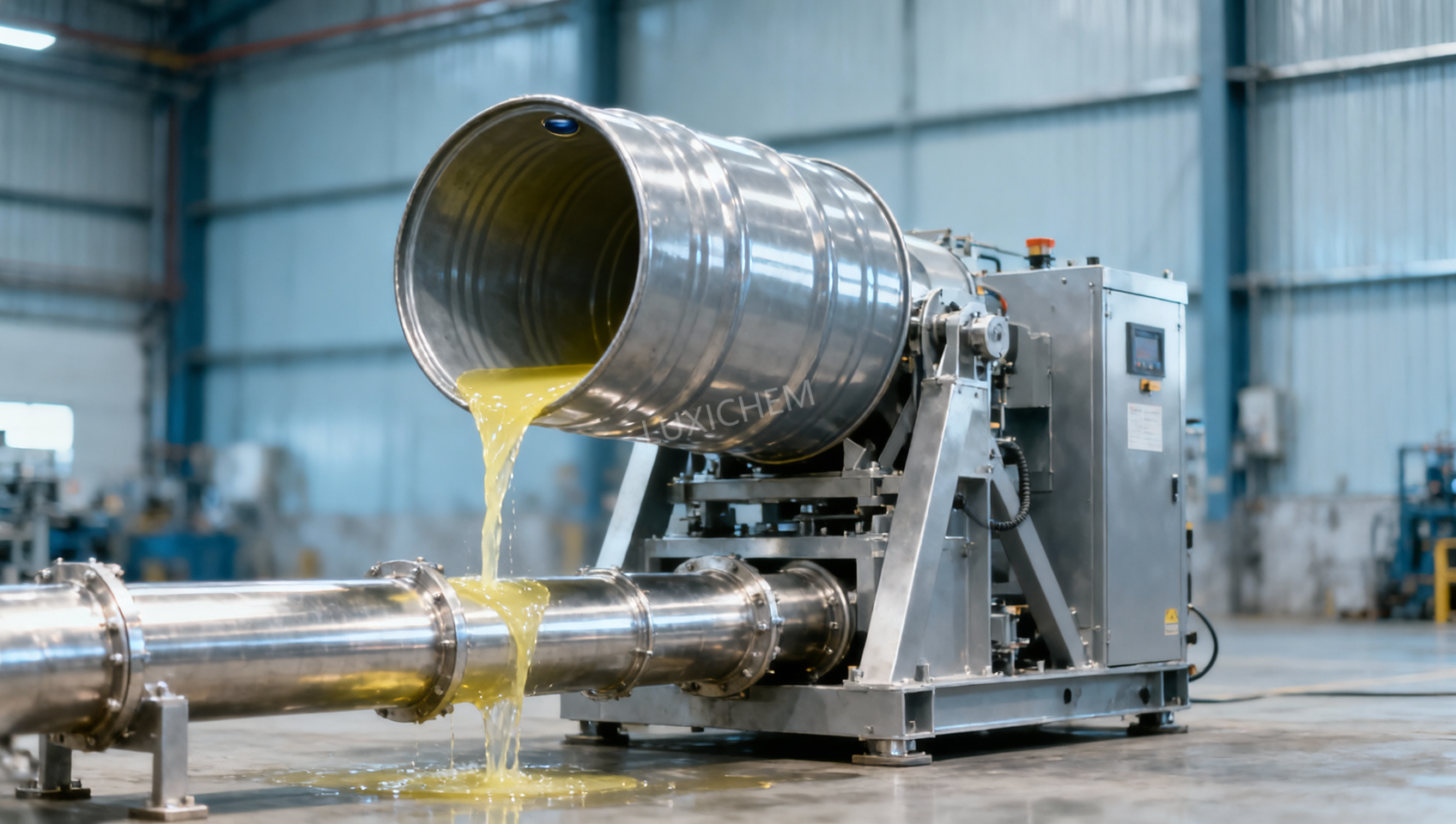
When Does Bulk Insecticides Procurement Justify On-Site Drum Handling Equipment?
Let’s cut to the core question finance leaders actually ask—not “what’s the textbook answer?” but “at what point does this capital outlay stop being a cost center and start paying for itself in real, auditable terms?” For bulk insecticides, the inflection point isn’t theoretical. It’s operational—and it’s anchored in volume, frequency, and labor reality.
At Luxi Chemical, we’ve seen procurement teams across Europe, Southeast Asia, and Latin America revisit this decision every 18–24 months—often after a near-miss incident, a repeated delay at the dock, or a third consecutive audit finding tied to manual drum handling. What they discover isn’t just about tonnage—it’s about how that tonnage moves through their site’s physical constraints, safety protocols, and labor contracts.
The 200-Metric-Ton Threshold: Why It’s Not Arbitrary
Yes, 200 metric tons annually is where ROI typically begins to solidify—but only if that volume is consistent, not lumpy. A single 200-ton shipment in Q3 doesn’t trigger the same calculus as four 50-ton deliveries spaced evenly across the year. Why? Because drum handling equipment isn’t optimized for peak load—it’s designed for rhythm.
Here’s what changes past that threshold:
- Labor efficiency shifts: Manual unloading of 200L HDPE drums (standard for many insecticide formulations) averages 12–15 minutes per drum with two operators—including PPE donning, drum inspection, valve alignment, and residue cleanup. At 200 MT/year (~250–300 drums), that’s ~60–75 labor hours *just for unloading*, before accounting for internal transfer or storage prep. Automated drum tilters and gravity-fed dispensing systems cut that to under 5 minutes per drum—translating to ~35% labor cost reduction in verified cases.
- Unloading time compresses by 50%: Not just clock time—cycle time. With manual handling, you’re scheduling around operator availability, shift handovers, and weather delays. With on-site equipment, a full trailer can be emptied in under 90 minutes, regardless of staffing gaps or rain delays. That matters when your formulation line runs 24/7 and downtime costs $1,200/hour in lost throughput.
- Safety exposure drops measurably: OSHA and EU-OSHA data consistently show drum-handling incidents spike above 150 MT/year in facilities without mechanical assist—especially with viscous or temperature-sensitive insecticides requiring heated trailers or double-bagging. The risk isn’t just musculoskeletal injury; it’s chemical exposure during valve misalignment or spill containment. At Luxi, our compliant bulk insecticides are formulated for stability and predictable flow, but even stable products demand precision handling when volumes scale.
What Makes This Decision Harder Than It Looks
Finance teams often underestimate two hidden variables: storage footprint and regulatory adjacency.
Drum handling gear isn’t just about the unloader. You need space for staging, secondary containment (often mandated for insecticides under EPA 40 CFR 264.175 or EU CLP Annex VI), and vapor mitigation if handling volatile carriers. A compact drum tilter may fit in a 3m x 3m bay—but add spill pallets, grounding cables, and drum washing stations, and you’re looking at 12+ m² of dedicated, classified space. That square-meter cost rarely appears in the capex model.
Also: not all insecticides behave the same way in bulk systems. Some crystallize below 15°C. Others form skin layers in static storage. And yes—some preservatives used in formulation intermediates, like Sodium dehydroacetate CAS#4418-26-2, require strict moisture control (<2.6% w/w) and ambient storage (<30°C)—meaning drum heating jackets or insulated transfer lines may be needed, not optional. These aren’t “nice-to-haves.” They’re operational prerequisites that change the break-even math.
Three Questions That Should Precede Any Capex Approval
Before signing off, ask your operations and EHS leads these—not once, but jointly:
- What’s our actual drum dwell time? If drums sit >72 hours post-unload before processing, automation won’t fix your bottleneck—you’ll just move inventory faster into a logjam.
- Are our current drums compatible with standard couplers and tilt angles? We’ve seen clients retrofit equipment only to find 30% of their supplier drums use proprietary bungs or non-standard neck threads—requiring custom adapters or manual intervention anyway.
- Who owns the residual product in the drum after dispensing? For high-value insecticides, even 0.5% retained volume adds up. If your contract places ownership of residuals with the buyer (common in FCA or EXW terms), that loss becomes part of TCO—and automated systems with high-recovery pumps may justify themselves faster than expected.
Where Luxi Chemical Fits In—Without Overpromising
We don’t sell drum handling equipment. But we do ship bulk insecticides in globally standardized 200L drums, ISO tanks, and lined IBCs—with documentation that aligns with GHS labeling, SDS version control, and UN transport compliance (UN 3082, Class 9). That consistency reduces integration friction. When your team evaluates ROI, they shouldn’t be troubleshooting drum compatibility or reclassifying shipments mid-transit.
And because our supply chain spans over 60 countries, we routinely support customers evaluating on-site equipment by providing batch-specific viscosity curves, thermal stability profiles, and even third-party test reports on pumpability at 10°C and 35°C—data that directly feeds into equipment sizing decisions.
The Bottom Line Isn’t Just About Tonnes
If your annual bulk insecticides volume sits between 120–180 MT, hold off on full automation—but invest in a pilot: one drum tilter, one grounded dispensing station, and three months of side-by-side tracking. Measure labor minutes saved, spill incidents avoided, and downtime reduced—not just against budget, but against production schedule adherence.
Because the real justification for on-site drum handling isn’t hitting 200 MT. It’s proving that every additional ton you bring in doesn’t multiply risk, delay, or cost—it multiplies control.
Related Picks
 Butylated Hydroxytoluene Price Drivers: Supply, Purity, and Purchasing Risk FactorsOct 21, 2026Butylated Hydroxytoluene price trends depend on supply stability, purity, logistics, and purchasing risk. Learn how to compare quotes wisely and reduce sourcing costs.
 Sodium Tripolyphosphate Price Trends: Raw Material and Energy ExposureOct 20, 2026Explore sodium tripolyphosphate price trends, from phosphate and soda ash costs to energy exposure. Learn how to compare quotes, manage sourcing risks, and make smarter purchasing decisions.
 Acetonitrile Shipment to Vietnam Successfully Dispatched; RCEP Benefits Boost Fine Chemical Trade with ASEANSep 16, 2026A shipment of industrial-grade acetonitrile from our company has recently been loaded and dispatched following the completion of standardized hazardous material packaging and container securing procedures.
 Nigerian Client’s Order of 4 Containers of Vinyl Acetate Successfully Loaded and Shipped to West AfricaSep 16, 2026We recently completed the loading of a vinyl acetate order for a Nigerian client; four containers of the product have been successfully packed and are ready for shipment to Nigeria.




Question Consultation
Send Us Your Inquiry Today

Luxi Chemical is a professional chemical product supplier with ample stock of all chemical categories and excellent quality, welcome your purchase inquiry.

