


When to Choose Contact vs Systemic Insecticides for Cotton Bollworm Control — Based on Pest Behavior & Canopy Penetration Needs
2026.09.17
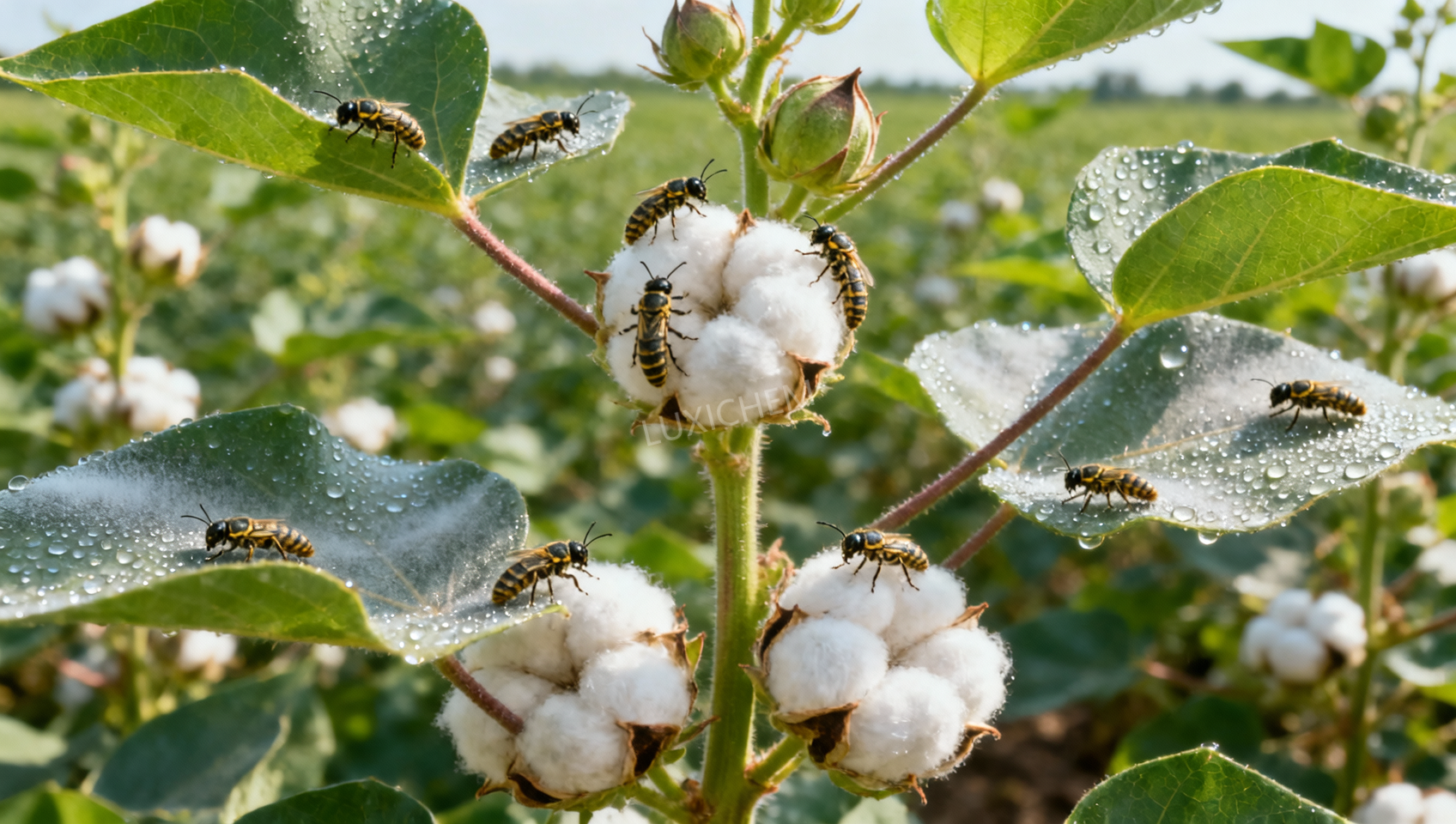
Cotton bollworm (*Helicoverpa armigera*) remains one of the most economically damaging pests in global cotton production. Its larval behavior—especially feeding site selection, developmental stage, and canopy position—dictates whether contact or systemic insecticides deliver reliable control. For field operators making real-time spray decisions, the choice isn’t about product preference; it’s about matching chemical mode of action to observable pest ecology and crop architecture at that moment.
Contact insecticides act only upon direct exposure: larvae must be on leaf surfaces, bracts, or outer boll structures when spray droplets land and dry. No residual translocation occurs. Efficacy collapses if larvae are concealed inside squares, bolls, or deep within dense foliage—places where spray penetration is physically limited. In contrast, systemic insecticides move through xylem or phloem, delivering active ingredients to internal tissues. But their speed, distribution uniformity, and concentration at critical feeding sites vary widely—and often lag behind rapid bollworm development.
So when *should* a contact insecticide be selected—not as default, but as the technically justified choice?
**First, when scouting confirms early instar larvae on exposed plant parts.** First- and second-instar bollworms feed primarily on young leaves, floral buds (squares), and anthers before boring into fruiting structures. They remain mobile and surface-active for 2–4 days post-hatching. During this window, contact products—including pyrethroids, organophosphates, and certain neonicotinoids applied as foliar sprays—achieve >90% mortality with proper coverage. Delay beyond this stage increases survival: third-instar larvae begin burrowing; fourth- and fifth-instar larvae reside almost exclusively inside bolls or stems, shielded from droplet impact.
**Second, when canopy density permits uniform spray deposition.** Cotton canopies evolve rapidly—from open, sparse growth at squaring to vertically layered, high-biomass structures at peak bloom and boll set. Contact efficacy drops sharply once leaf area index (LAI) exceeds ~3.5–4.0 m²/m². At that point, spray drift, droplet interception by upper leaves, and shadowing reduce deposition on lower fruiting branches by 60–80%. Field trials across India and Pakistan show that contact insecticides applied under LAI > 4.0 require 30–50% higher application volumes—and still fail to suppress boll damage rates above 15%, even with calibrated nozzles and optimal boom height. Systemics may underperform too, but their failure mode differs: slow uptake or insufficient translocation, not physical exclusion.
**Third, when resistance management strategy prioritizes rotation over persistence.** Repeated use of systemics—particularly neonicotinoids and diamides—has driven measurable shifts in bollworm susceptibility across major cotton-growing regions. Contact insecticides with distinct modes of action (e.g., acetylcholinesterase inhibitors, sodium channel modulators) offer tactical rotation options *only if deployed early*, before larvae enter refugia. Using them late—on mature borers—is not just ineffective; it adds selection pressure without yield benefit. Operators who reserve contact products for confirmed early infestations reduce the number of non-lethal exposures per season, slowing resistance development more effectively than alternating chemistries regardless of timing.
**Fourth, when application logistics favor fast-acting, short-residual control.** High-temperature, low-humidity conditions accelerate spray drying and reduce rainfastness—but also increase larval mobility and feeding rate. A contact insecticide with rapid knockdown (e.g., <2 hours) can halt feeding before significant boll damage occurs, even if residual activity lasts only 3–5 days. Systemics may take 48–72 hours to reach lethal tissue concentrations—time during which larvae continue feeding and moving deeper. This delay matters most during synchronized hatches following monsoon rains or irrigation events, when larval populations surge across fields within 24–48 hours.
There are hard limits, however. Contact insecticides cannot compensate for poor spray technique. Droplet size matters: VMD below 250 µm improves coverage on hairy leaves but increases drift risk; VMD above 400 µm reduces evaporation loss but misses small larvae in leaf axils. Adjuvant selection—non-ionic surfactants versus oil-based penetrants—must align with target surface (waxy vs. pubescent) and water hardness. And crucially, no contact product overcomes physiological barriers: once larvae seal themselves inside bolls with frass plugs, no amount of spray volume or pressure delivers active ingredient to the feeding site.
This leads to a practical decision framework—not a checklist, but a sequence of field-verified thresholds:
- If >70% of observed larvae are ≤3 mm long *and* located on upper leaves/squares → contact option viable.
- If LAI < 3.0 *and* wind speed < 15 km/h during application → contact delivery feasible.
- If last systemic application was ≤7 days ago *and* local resistance monitoring shows >30% reduced susceptibility to that class → contact rotation advisable.
- If boll damage is already visible on >5% of sampled bolls → contact use is unlikely to recover yield; shift focus to next-generation scouting and harvest timing.
One final consideration: chemistry compatibility. Some contact insecticides interact unpredictably with adjuvants, fungicides, or plant growth regulators commonly tank-mixed in cotton programs. While formulation stability data exists for many commercial products, field-level phytotoxicity or reduced bioavailability remains operator-dependent—especially under heat stress. This is where understanding base chemical properties becomes operational knowledge. For example, compounds like 1,4-Benzoquinone CAS#106-51-4, used industrially in synthesis of certain oxidation-sensitive intermediates, illustrates how redox potential and pH-dependent solubility influence formulation stability—factors that indirectly affect spray solution integrity when co-applied with alkaline or acidic tank-mix partners.
Ultimately, choosing contact over systemic insecticides for bollworm control is less about “which is stronger” and more about recognizing a narrow, time-bound window where surface exposure, canopy openness, and larval vulnerability align. Missing that window doesn’t mean the contact product failed—it means the decision logic misaligned with pest phenology. The most effective operators treat insecticide selection not as a chemical choice, but as a dynamic agronomic calculation—one updated daily with scouting data, not calendar dates.

Related Picks
 Butylated Hydroxytoluene Price Drivers: Supply, Purity, and Purchasing Risk FactorsOct 21, 2026Butylated Hydroxytoluene price trends depend on supply stability, purity, logistics, and purchasing risk. Learn how to compare quotes wisely and reduce sourcing costs.
 Sodium Tripolyphosphate Price Trends: Raw Material and Energy ExposureOct 20, 2026Explore sodium tripolyphosphate price trends, from phosphate and soda ash costs to energy exposure. Learn how to compare quotes, manage sourcing risks, and make smarter purchasing decisions.
 Acetonitrile Shipment to Vietnam Successfully Dispatched; RCEP Benefits Boost Fine Chemical Trade with ASEANSep 16, 2026A shipment of industrial-grade acetonitrile from our company has recently been loaded and dispatched following the completion of standardized hazardous material packaging and container securing procedures.
 Nigerian Client’s Order of 4 Containers of Vinyl Acetate Successfully Loaded and Shipped to West AfricaSep 16, 2026We recently completed the loading of a vinyl acetate order for a Nigerian client; four containers of the product have been successfully packed and are ready for shipment to Nigeria.




Question Consultation
Send Us Your Inquiry Today

Luxi Chemical is a professional chemical product supplier with ample stock of all chemical categories and excellent quality, welcome your purchase inquiry.

