


Phosphate Fertilizer Market Shifts: Supply Risks for Agricultural Buyers
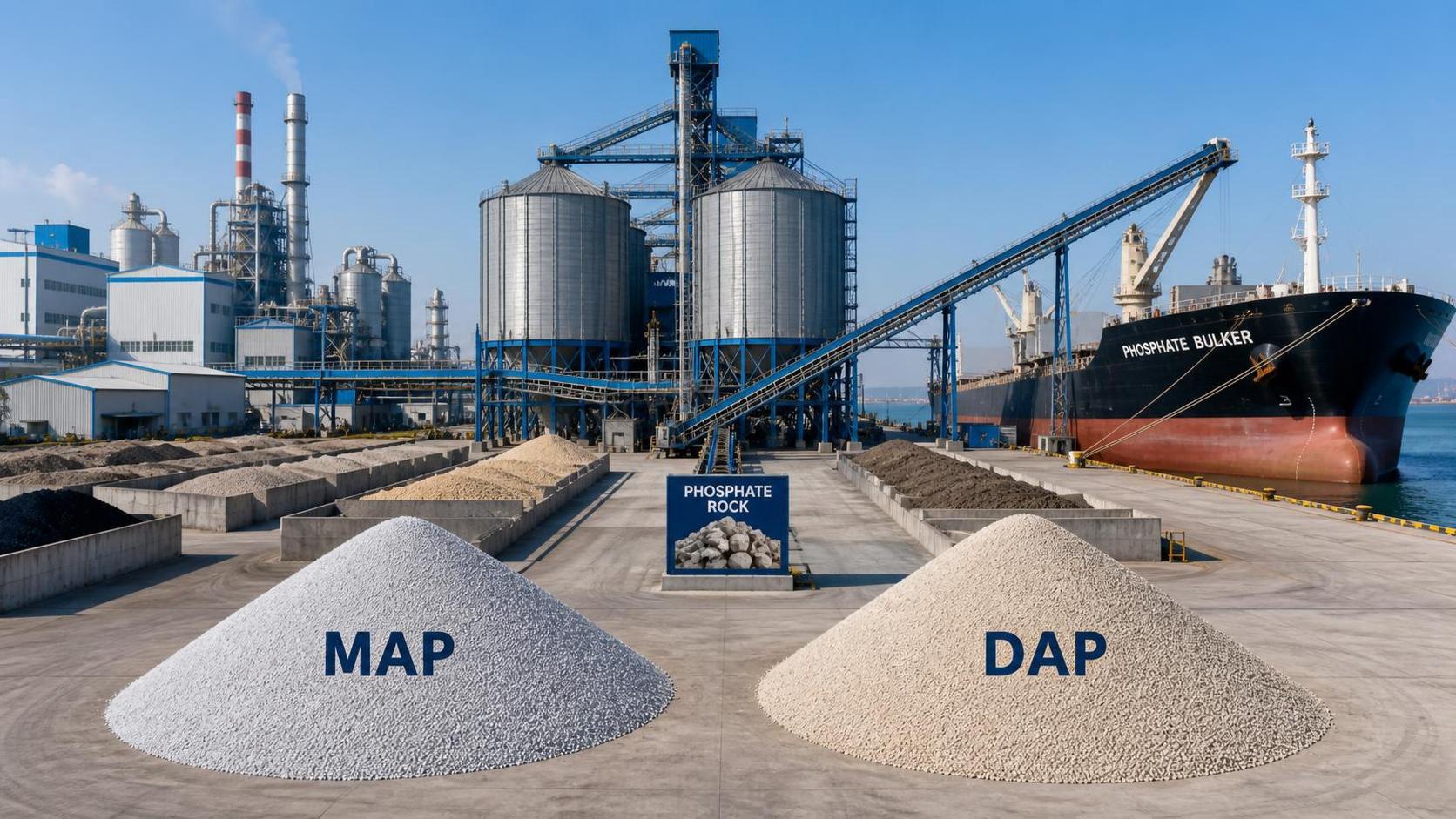
Phosphate fertilizer availability is becoming harder to judge from a quoted price or a supplier's stated production capacity alone. Supply can appear adequate while shipment timing, grade consistency, or the usable nutrient value of delivered material becomes uncertain. The market pressure stems from a chain of linked constraints: phosphate rock quality, sulfur and acid availability, processing capacity, trade policy changes, port handling, and the timing of seasonal demand. A disruption at any one point can alter the practical availability of MAP, DAP, TSP, SSP, and phosphate-containing compound fertilizers.
For agricultural programs, the main exposure is rarely a complete absence of product across every origin. More often, it is a mismatch between the material required, the period when it must arrive, and the grade actually available in the market. A substitute grade may contain similar total nutrients yet behave differently in a blending line, storage environment, or soil application plan. This makes specification discipline more important when supply conditions are unstable.
Supply Risk Begins Upstream of Fertilizer Granulation
Phosphate rock is not a uniform raw material. Deposits differ in phosphate content, impurity profile, particle characteristics, and suitability for acidulation. These differences influence acid consumption, process yield, gypsum generation, filtration behavior, and the final composition of phosphate fertilizer. When producers switch rock sources or operate with a blended rock slate, the impact may appear downstream as changed granule hardness, moisture, free acidity, nutrient analysis, or storage behavior.
A lower-grade rock does not automatically make finished fertilizer unsuitable. The issue is whether the processing route and quality-control system are designed for that feedstock. A product may still meet its declared nutrient analysis while carrying a different level of moisture or a changed physical profile. Such variations matter where material will be stored for extended periods, transferred through conveyors, blended with urea or potash, or applied through equipment sensitive to dust and particle-size distribution.
Sulfur is another important variable because sulfuric acid is fundamental to wet-process phosphoric acid production. Tight sulfur supply or elevated sulfur costs can move through the value chain quickly. The resulting pressure does not always show up only as a higher fertilizer offer. It can also change production scheduling, favor higher-margin grades, reduce spot availability, or encourage suppliers to allocate material toward established contract destinations.
Phosphoric acid is the bridge between mining and many finished phosphate products. A disruption in acid production can constrain DAP and MAP output even when granulation assets are available. Conversely, an interruption in ammonia supply affects ammoniated phosphates more directly than products based primarily on acidulated rock. Treating all phosphate fertilizers as exposed to the same risk can therefore lead to an incorrect sourcing decision.
Trade Conditions Change the Meaning of Available Supply
Export restrictions, licensing requirements, inspections, changing duties, and freight disruptions can turn nominal supply into inaccessible supply. A cargo listed as available at origin is not necessarily available for a specific destination within the needed delivery window. Documentation lead time, vessel nomination, port congestion, transshipment exposure, and inland transport capacity all affect the real arrival date.
Supply risk is especially acute when a purchase plan relies on a single trade lane. Geographic diversity may reduce exposure, but only when the alternative origins can supply an equivalent product. DAP from different production routes can meet a common grade description while differing in granule strength, size distribution, moisture, and trace-element profile. These differences can be relevant where the product is combined with other fertilizers before field use.
Lead-time assumptions also require scrutiny. A supplier may distinguish between product ready for loading, product scheduled for production, and product subject to vessel confirmation. These are materially different states. A delivery promise based on a future production slot carries exposure to raw-material interruptions and plant operating changes; a warehouse release carries more exposure to local inventory accuracy and transport execution. The contract language should make this distinction visible rather than treating every quoted volume as physically equivalent.
Grade Names Can Conceal Important Differences
MAP and DAP are frequently evaluated through their nutrient labels, but total nitrogen and phosphate content do not describe the full handling and agronomic picture. Water-soluble phosphate, citrate-soluble phosphate, moisture, free acid, and granule size influence how the material performs in storage, blending, and use. A grade with acceptable total phosphate but a different solubility profile may not be interchangeable for a particular application plan.
Particle-size distribution is often underestimated during periods of short supply. Fine material can generate more dust, segregate in bulk storage, and alter blend uniformity. Excessive oversize particles can affect spreading patterns and create handling difficulties. Granule strength matters after multiple transfers: loading at origin, discharge, bagging or bulk transfer, warehouse movement, and field distribution. A sample taken before shipment may not represent the material condition at final receipt if the logistics route involves repeated handling.
The same caution applies to TSP and SSP. Their nutrient concentration, sulfur contribution, physical form, and impurity tolerance differ from ammoniated phosphates. Replacing one with another solely on a nutrient-cost calculation can overlook storage capacity, blending compatibility, land application requirements, and the nutrient balance of the broader fertilizer program.
Inventory Is a Buffer Only When Its Condition Is Known
Holding additional material can reduce exposure to vessel delays and production interruptions, but inventory quality deteriorates when storage conditions are poorly matched to the product. Phosphate fertilizers can absorb moisture, cake under pressure, and form lumps where humidity fluctuates or water enters through damaged packaging. Bulk piles need protection from ground moisture and roof leaks, while bagged material requires stable stacking practices that do not crush lower layers or obstruct air circulation.
Older inventory should not simply be counted as equivalent to fresh material. Physical inspection should consider bag integrity, visible agglomeration, dust accumulation, discoloration, and evidence of wetting. Representative sampling is important because a clean outer layer can conceal compacted zones deeper in a pile. Where material is intended for mechanical blending, a small-scale flow and compatibility assessment can reveal problems that a nutrient certificate alone will not show.
Segregation is another hidden cost. A bulk product with a broad particle-size range may separate during conveyance or repeated loading. The final blend can then vary between truckloads or bagging runs even if the initial mix was correct. This is particularly relevant when phosphate material is combined with coarse potash, prilled nitrogen products, or micronutrient carriers with very different size and density characteristics.
Separate Supply Qualification from Product Qualification
A supplier can be commercially acceptable while a particular cargo is unsuitable for the required use. Conversely, a technically suitable product may carry delivery terms that create too much schedule exposure. These evaluations need separate evidence. Supply qualification addresses origin, production status, loading window, logistics route, payment conditions, and contingency arrangements. Product qualification addresses analysis, solubility, moisture, particle size, free acidity, packaging, and compatibility with the intended handling system.
Sampling terms deserve precise attention. A pre-shipment certificate is useful, but it should be linked to a defined sampling method, lot identity, and test basis. A retained sample supports later investigation when receipt analysis differs from the shipping documents. Without clear lot traceability, disagreement over a nutrient or moisture result can become difficult to resolve after the cargo has been unloaded or mixed with other stock.
Contract descriptions should avoid vague wording such as “standard quality” where the physical characteristics are important. A practical specification identifies the grade, tolerance bands where applicable, minimum soluble nutrient basis, maximum moisture, permitted particle-size range, packaging format, and the inspection point. It should also clarify whether the quoted quantity refers to gross weight, net weight, or nutrient basis. These details are not administrative extras when margins are affected by product losses, rehandling, or unexpected blending adjustments.
Cross-Commodity Signals Can Reveal Pressure Earlier
Phosphate fertilizer markets should not be viewed in isolation. Changes in sulfur availability, ammonia operating conditions, phosphoric acid production, fuel costs, and shipping schedules can indicate pressure before a finished-product shortage becomes visible. The interpretation still requires care. Higher sulfur costs may affect acid-intensive products, while ammonia constraints have a more direct effect on DAP and MAP. Freight disruption can be severe for distant import routes yet have limited consequences for material already positioned in regional warehouses.
Chemical supply chains also show why material identity matters. A hygroscopic inorganic salt such as Lanthanum(III) chloride CAS#10099-58-8 requires controlled storage and distinct handling because moisture uptake changes its condition. Fertilizer materials are different products with different uses, yet the operational lesson is similar: storage instructions, packaging integrity, and lot-specific data cannot be replaced by a general product name. Moisture-sensitive material that appears unchanged at dispatch can behave differently after transit through humid ports or extended warehouse storage.
When phosphate supply becomes constrained, substitutions are often proposed quickly. A sound substitution review compares nutrient form, application timing, sulfur contribution, physical properties, and equipment limits. Replacing a granular phosphate source with a powder or a finer material may introduce dust-control, blending, and spreading issues. Replacing an ammoniated phosphate with a lower-nitrogen phosphate source can require a separate nitrogen adjustment, which changes the final blend composition and potentially its storage characteristics.
Managing the Delivery Window
Seasonal demand makes timing part of product quality. Material delivered after the intended application period may still retain its nutrient analysis, but its commercial value and operational usefulness are changed. Delivery plans therefore benefit from separating base volume, optional volume, and contingency volume rather than placing all expected demand into a single arrival window.
A staged schedule can reduce the consequence of one late cargo, provided each stage is large enough to justify transport and storage handling. The practical limit is warehouse capacity: splitting deliveries without protected space can create more exposure to wetting, double handling, and stock confusion. Batch identification and a simple stock rotation method are particularly important when similar grades from multiple origins are held at the same location.
Market volatility also changes the value of flexibility. A lower unit price can be offset by restrictive loading terms, limited tolerance for schedule changes, or a product specification that leaves no room for blending adjustments. The stronger commercial position is created by knowing which properties are fixed requirements, which can be adjusted through formulation, and which delivery delays would disrupt the agricultural calendar.
Phosphate fertilizer supply risks are best assessed as a combination of raw-material exposure, conversion capacity, trade access, physical product condition, and arrival timing. A market offer becomes meaningful only after those elements are connected to the required grade and actual handling route. That level of detail reduces the likelihood that an apparently available cargo creates a problem only after it reaches storage or blending operations.
Related Picks
 Butylated Hydroxytoluene Price Drivers: Supply, Purity, and Purchasing Risk FactorsOct 21, 2026Butylated Hydroxytoluene price trends depend on supply stability, purity, logistics, and purchasing risk. Learn how to compare quotes wisely and reduce sourcing costs.
 Sodium Tripolyphosphate Price Trends: Raw Material and Energy ExposureOct 20, 2026Explore sodium tripolyphosphate price trends, from phosphate and soda ash costs to energy exposure. Learn how to compare quotes, manage sourcing risks, and make smarter purchasing decisions.
 Acetonitrile Shipment to Vietnam Successfully Dispatched; RCEP Benefits Boost Fine Chemical Trade with ASEANSep 16, 2026A shipment of industrial-grade acetonitrile from our company has recently been loaded and dispatched following the completion of standardized hazardous material packaging and container securing procedures.
 Nigerian Client’s Order of 4 Containers of Vinyl Acetate Successfully Loaded and Shipped to West AfricaSep 16, 2026We recently completed the loading of a vinyl acetate order for a Nigerian client; four containers of the product have been successfully packed and are ready for shipment to Nigeria.




Question Consultation
Send Us Your Inquiry Today

Luxi Chemical is a professional chemical product supplier with ample stock of all chemical categories and excellent quality, welcome your purchase inquiry.

